For parents & clinicians
Baby Communication Milestones From Birth to 12 Months: What Most Babies Do, and When to Ask
The short answerMost babies make sounds other than crying by 2 months, coo by 4 months, take turns making sounds with you by 6 months, and babble strings like "mamamama" by 9 months. By 12 months, most wave bye-bye, call a parent "mama," "dada," or another special name, and understand "no."These CDC milestones are skills that at least 75% of babies are expected to show by that age, so missing one is a reason to talk with your child's doctor and ask about developmental screening, not a diagnosis. Losing skills, or any worry about hearing, is a reason not to wait.[1] [2] [3]
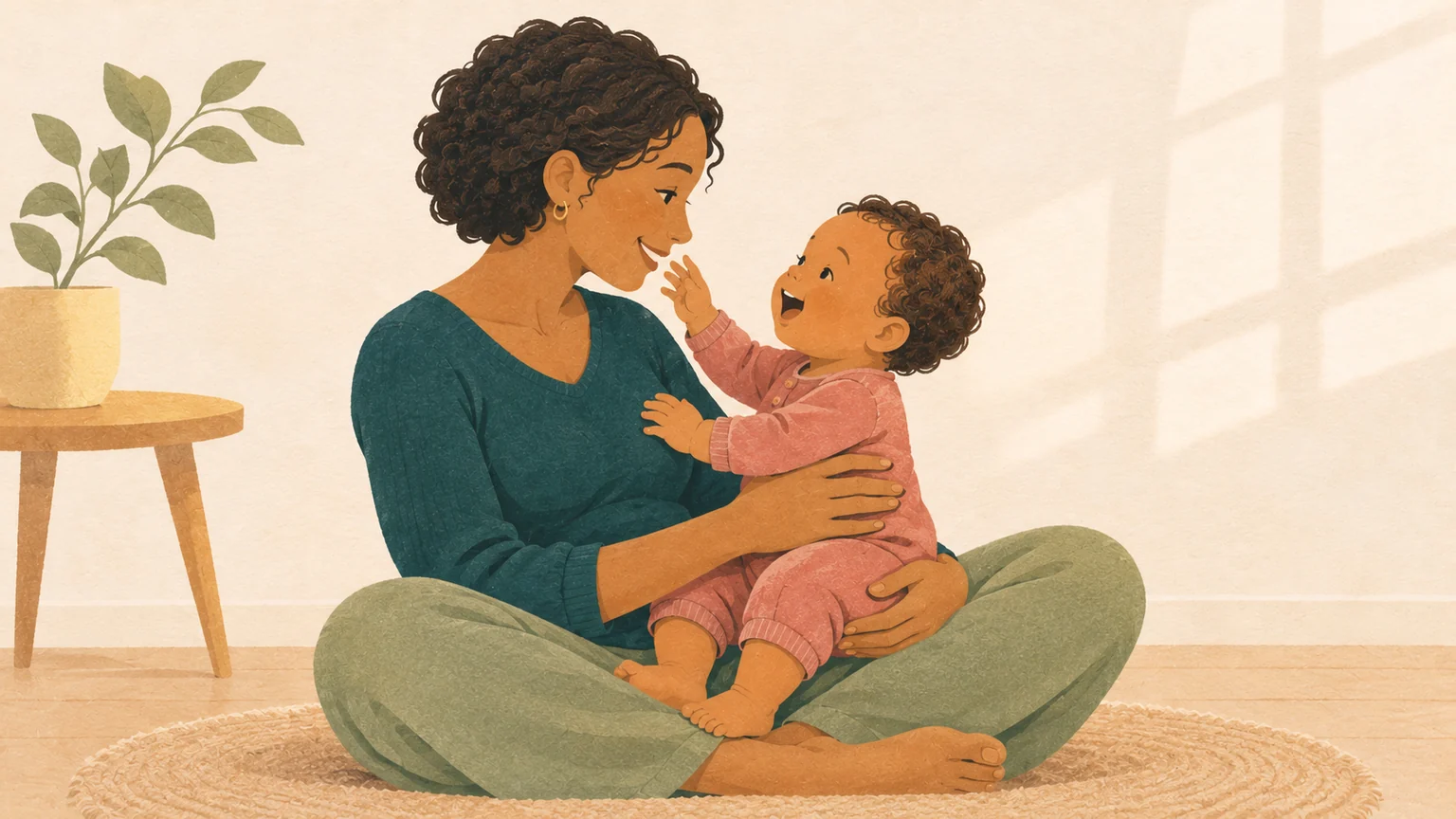
Long before your baby says a first word, you get to know each other through cries, looks, smiles, and sounds. Those early coos and strings of "bababa" are part of how babies learn to communicate. If you've found yourself comparing your baby with a cousin, a friend's child, or a milestone chart, you're not alone.
This article summarizes milestone guidance and research on how babies learn to communicate. It cannot tell you whether your baby has a delay. Only a qualified professional who sees your child can do that.
Key takeaways
- Communication starts long before words. Crying, looking, smiling, cooing, babbling, and gestures such as lifting arms to be picked up all count. [1] [3] [4]
- CDC milestones are set for when most babies are expected to reach them. Each one is something at least 75% of children are expected to do by that age, chosen to discourage a "wait and see" approach when a skill is missing. [1] [2]
- Babies vary, and premature babies are measured by corrected age. Children develop at different rates, even within one family. For babies born early, using corrected age for the first 2 years gives a fairer picture. [3] [4] [11]
- Babbling with real syllables usually starts between about 5 and 10 months. Late babbling has been linked with later speech and language difficulties and with hearing loss, but it is not a diagnostic test for any condition. [6] [7]
- Back-and-forth responding seems to help. In two small laboratory studies, babies whose mothers responded promptly to their babbling began making more mature, speech-like sounds. [8] [9]
- Hearing matters. All babies should have a hearing screening by 1 month of age, and you can ask for a hearing test at any age if you are worried. [5]
- You do not need to wait for a checkup. If your baby is not meeting milestones, has lost skills, or you are concerned, talk with your child's doctor and ask about screening. [1] [10]
Both views include the full guide. Clinician view adds research details.
What counts as communication in the first year?
Communication in the first year includes every way a baby connects with you: crying, looking at your face, smiling, cooing, babbling, laughing, and later, gestures and first words. Understanding develops alongside these skills.
The National Institute on Deafness and Other Communication Disorders (NIDCD) describes the first signs of communication as a baby learning that a cry brings food, comfort, and companionship. Newborns begin to recognize important sounds, such as the voice of a parent, and by 6 months most babies recognize the basic sounds of their native language. [4]
Milestone lists usually split skills into hearing and understanding on one side and making sounds or "talking" on the other. Social milestones, such as smiling at you or playing peek-a-boo, overlap heavily with communication in the first year. [1] [3]
What communication milestones do most babies reach by each age?
The table below lists the CDC's language and communication milestones for the first year, with a few related social milestones. Each item is a skill that most children (75% or more) are expected to do by that age; many babies do these things earlier. [1]
| By about | Language and communication (CDC) | Related social milestones (CDC) |
|---|---|---|
| 2 months | Makes sounds other than crying. Reacts to loud sounds. [1] | Calms down when spoken to or picked up. Looks at your face. Smiles when you talk to or smile at them. [1] |
| 4 months | Makes cooing sounds like "oooo" and "aahh." Makes sounds back when you talk. Turns head toward the sound of your voice. [1] | Smiles on their own to get your attention. Looks at you, moves, or makes sounds to get or keep your attention. [1] |
| 6 months | Takes turns making sounds with you. Blows "raspberries." Makes squealing noises. [1] | Knows familiar people. Laughs. [1] |
| 9 months | Makes a lot of different sounds like "mamamama" and "bababababa." Lifts arms up to be picked up. [1] | Looks when you call their name. Smiles or laughs when you play peek-a-boo. [1] |
| 12 months | Waves "bye-bye." Calls a parent "mama," "dada," or another special name. Understands "no" (pauses briefly or stops when you say it). [1] | Plays games with you, like pat-a-cake. [1] |
| 15 months | Tries to say one or two words besides "mama" or "dada," like "ba" for ball. Points to ask for something or to get help. [1] | Shows you an object they like. [1] |
The 15-month row is included because first words beyond "mama" and "dada" sit there on the CDC checklist, just past the first birthday.
The American Speech-Language-Hearing Association (ASHA) uses different age bands. Its list for 10 to 12 months includes pointing, waving, and showing or giving objects, trying to copy sounds you make, responding to simple words and phrases like "Go bye-bye," and saying one or two words, like mama, dada, hi, and bye. [3]
Why do different milestone charts give different ages?
Charts differ mainly because they answer different questions. Some describe when an average baby reaches a skill. The CDC checklists describe when most babies have reached it.
When the CDC and the American Academy of Pediatrics revised the checklists in 2022, the working group chose milestones that at least 75% of children would be expected to reach by each checkup age. They explained that lists based on the median, when only half of children have a skill, can encourage families and clinicians to wait and see. The same revision removed separate "warning signs" because not reaching a milestone that most children are expected to have reached already warrants a closer look and consideration of screening. [2]
That is why first words can appear at about 12 months on one chart and on the 15-month CDC checklist. ASHA and NIDCD describe one or two words around the first birthday, while the CDC places "tries to say one or two words besides mama or dada" at 15 months, when most children are expected to be doing it. [1] [2] [3] [4]
The CDC is also clear that its milestone materials are not a substitute for standardized, validated developmental screening tools. [1]
When do babies start babbling, and why does it matter?
Most babies begin canonical babbling, meaning well-formed syllables such as "ba-ba" or "da-da," somewhere between about 5 and 10 months of age. [6] [7] By 9 months, the CDC expects most babies to make many different sounds like "mamamama" and "bababababa." [1]
Researchers pay attention to babbling because these syllables are building blocks for words. A 2019 review found that this age range is fairly consistent across many languages, including English, Dutch, Swedish, Spanish, and German, although individual babies vary considerably. [6]
Late babbling has been linked with later difficulties in several studies:
- Later vocabulary: the review describes research in which babies who were not producing canonical syllables at 10 to 12 months had smaller expressive vocabularies at 18, 24, and 30 months. [6]
- Hearing loss: babies with hearing loss started canonical babbling later than hearing babies in studies summarized in the same review. [6]
- Other conditions: in a study of 1,536 infants at high risk for developmental problems, checked at about 10 months corrected age, late babbling was uncommon but was often linked with genetic, neurological, anatomical, or physiological conditions. More than half of the late babblers had no prior significant medical diagnosis when the late babbling was found. The authors suggested late babbling may predict later speech, language, and reading problems. [7]
Late babbling is not a diagnosis. In the 2019 review, studies of babies later diagnosed with autism, Rett syndrome, or fragile X syndrome were few and inconsistent. These babies were less likely to babble canonically on average, but some reached the milestone on time. The authors called babbling a promising marker for further research, not a test. [6] If your baby is not babbling with syllables by around 10 months, the practical step is to mention it to your child's doctor and ask about a hearing check.
Do gestures count as communication?
Yes. Gestures are one of the main ways babies communicate before they talk. On the CDC checklists, most babies lift their arms to be picked up by 9 months, wave bye-bye by 12 months, and point to ask for something or get help by 15 months. [1] ASHA's list for 10 to 12 months includes pointing, waving, and showing or giving objects to others. [3]
Gestures, eye contact, and shared attention are also part of what clinicians look at when they consider autism. Our guide to early signs of autism in toddlers explains those signs and what research says about them. This article focuses on typical communication development, not autism screening.
How much do babies vary?
A lot. ASHA notes that each child develops uniquely, even within the same family, and may meet some milestones earlier or later than others. [3] NIDCD describes a natural progression that children follow at different rates. [4] CDC milestones are set for the age when at least 75% of children are expected to have a given skill; some babies are still working on it at that age. [2]
For babies born early, the American Academy of Pediatrics advises using a premature baby's corrected age during the first 2 years. To find it, subtract the number of weeks your baby was born early from their age in weeks since birth. A baby born at 32 weeks who is now 4 months old has a corrected age of about 2 months, and that is the age to compare with milestone lists. [11] CDC checklists also ask whether your baby was born prematurely, so tell your child's doctor. [1]
For families who speak more than one language, ASHA encourages parents to talk to their child in the languages they are most comfortable using, and notes that early exposure helps children learn language best. [3]
How does hearing affect early communication?
Babies learn to talk largely by hearing the people around them, so hearing problems can delay communication. The CDC says hearing loss can affect a child's ability to develop communication, language, and social skills, and that children who start services earlier are more likely to reach their full potential. [5]
U.S. guidance follows "1-3-6" benchmarks: hearing screening before 1 month of age, a full diagnostic hearing evaluation by an audiologist before 3 months if a baby does not pass, and enrollment in early intervention before 6 months if hearing loss is found. [5] NIDCD notes that a speech or language delay is sometimes caused by hearing loss, and that a hearing test is often part of a speech and language evaluation. [4]
Passing the newborn screening does not rule out later problems. Some hearing loss develops or gets worse after birth. The CDC advises that if you think your child might have hearing loss, you should ask the doctor for a hearing test as soon as possible. Hearing tests for babies are not painful. [5]
How can parents support communication in the first year?
You do not need a special routine to connect with your baby. Notice their sounds, looks, and gestures, and respond in the moments you already share.
Two small laboratory studies suggest why this may matter:
- In a study of 30 babies around 8 months old, mothers were asked to respond by smiling, moving closer, and touching their baby. Half responded right after their baby made a sound; the other half gave the same number of responses at times that did not match their baby's sounds. Babies whose mothers responded promptly made more mature, speech-like sounds, and the change lasted after the session. [8]
- In a later study of babies around 9 and a half months old, babies whose mothers spoke right after they babbled began building patterns from their mother's speech into their own babbling. Babies who heard their mother's speech at times unrelated to their babbling did not. [9]
Both studies were small and took place over a short time in a lab. They help us understand how babies respond during an interaction; they cannot tell us whether a particular routine changes long-term language outcomes.
Practical ideas from CDC and ASHA guidance include: [1] [3]
- Respond when your baby makes sounds. Smile, talk back, and copy their sounds to take turns "talking."
- Talk about what you are doing during feeding, dressing, and bathing.
- Name things your baby looks at or points to.
- When your baby babbles a sound, repeat it and add a simple word, such as "bababa... book!"
- Read, sing, and play games like peek-a-boo and pat-a-cake.
- Limit screen time to video calls with loved ones. The CDC says screen time is not recommended for children younger than 2, because babies learn by talking, playing, and interacting with others. Our article on what screen time research shows covers this in more detail.
When should you talk with your child's doctor?
You can bring up a concern at any time, not just at a scheduled checkup. The CDC's advice is: "You know your child best. Don't wait." If your baby is not meeting one or more milestones, has lost skills they once had, or you have other concerns, talk with your child's doctor and ask about developmental screening. [1]
The American Academy of Pediatrics recommends that pediatric clinicians watch development at every well-child visit and use a standardized developmental screening test at the 9-, 18-, and 30-month visits. A concern raised at any visit should be followed by standardized screening or a direct referral to intervention and specialty care. [10] Our guide to what happens at well-child visits explains these visits.
Reasons to raise communication concerns promptly include:
- Your baby does not react to loud sounds or turn toward voices. [1] [3]
- Your baby is not meeting one or more milestones for their age, using corrected age if born early. [1] [11]
- Your baby is not babbling with syllables like "ba" or "da" by around 10 months. [6] [7]
- Your baby did not pass a hearing screening and has not had a full hearing test, or you have any worry about hearing. [5]
- Your baby has lost sounds, words, or other skills they used to have. Contact your child's doctor promptly if this happens. [1]
- Something feels off to you, even if you cannot name it. [1]
If you or the doctor remain concerned, the CDC suggests asking for a referral to a specialist and contacting your state's early intervention program. [1] In the U.S., you can contact early intervention yourself. Our guide on how to get early intervention services explains how.
What milestones can and cannot tell you
- Milestones are a guide for watching, not a test. The CDC says its checklists are not a substitute for standardized, validated screening tools. [1]
- One missed milestone is not a diagnosis. It is a reason to look more closely, often with a screening tool. [2]
- Some milestones rest on more data than others. About 80% of the revised CDC milestones had normative data from at least one source. Social-emotional and cognitive milestones had the least. [2]
- Babbling research is still developing. Studies of babbling in specific conditions are few, use different methods, and do not agree on details. [6]
- The responsiveness studies were small and short. They show how babies' sounds change in a session, not long-term effects. [8] [9]
What you can do now
- Compare gently, using the right age. Look at the CDC milestones for your baby's age, using corrected age if they were born early. [1] [11] Our milestone checker can help you note what you have seen and prepare questions for your baby's doctor. It is a conversation aid, not a screening tool.
- Respond and take turns. Answer your baby's sounds, copy them, and talk through daily routines. [1] [3] [8] [9]
- Keep an eye on hearing. Confirm that your baby had a newborn hearing screening and any follow-up test. Ask for a hearing test if you are unsure. [5]
- Write down what you notice. A few notes about sounds, gestures, and anything you are unsure about can help you remember what to say at the next visit. This is a practical suggestion, not a test.
- Ask about screening if you are worried. You do not need to wait for the 9-month visit. [1] [10]
- Act quickly if skills are lost. Contact your child's doctor promptly if your baby loses sounds, words, or other skills. [1]
Questions to ask your child's doctor
Clinician view: evidence notes on first-year communication milestones
Additional detail for clinicians. Parent-facing guidance on hearing, lost skills, and when to raise concerns remains visible in both reading views.
CDC/AAP milestone revision. Zubler et al. (Pediatrics 2022) describe the AAP working group convened for CDC's Learn the Signs. Act Early. program. Subject matter experts set 11 criteria, including milestones that at least 75% of children are expected to achieve by a given health supervision visit and that are easily observed in natural settings. The revision produced a 26.4% reduction in the number of milestones and replaced 40.9% of previous ones. Of 94 retained milestones, about one third moved to a different age, and of those, 67.7% moved older. About 80% of final milestones had normative data from at least one source, with social-emotional and cognitive milestones least supported. Developmental warning signs were removed. The authors note that expert opinion determined placement when evidence was mixed: a milestone reached by 50% of children at 11 months and 90% at 16 months was placed on the 15-month checklist. [2]
Surveillance and screening. AAP clinical report (Lipkin and Macias, Pediatrics 2020): developmental surveillance at every health supervision visit; standardized screening at 9, 18, and 30 months; concerns on surveillance at any visit should be followed by standardized screening or direct referral to intervention and specialty care. We read the abstract only. [10]
Canonical babbling. Lang et al. (Curr Dev Disord Rep 2019), a narrative review: canonical babbling onset in typically developing infants is reported between 5 and 10 months across several languages; persistence of precanonical vocalizations beyond 10 to 12 months may indicate atypical vocal development; few studies in autism, Rett syndrome, and fragile X syndrome, with inconsistent definitions and paradigms; some affected infants babble on time. Oller et al. (Am J Ment Retard 1998): 1,536 high-risk infants assessed at about 10 months corrected age by parent questionnaire; late canonical babbling was infrequent and often associated with genetic, neurological, anatomical, or physiological abnormalities, and over half of cases had no prior significant diagnosis. We read the Oller abstract only. [6] [7]
Contingent responsiveness. Goldstein, King, and West (PNAS 2003): 30 infants (mean age 8 months 14 days); contingent maternal responses, compared with yoked noncontingent responses, increased more complex and mature vocalizations, with effects persisting after the manipulation. Goldstein and Schwade (Psychol Sci 2008): mothers of 9.5-month-olds gave contingent or noncontingent vocal models; only contingently responded-to infants restructured babbling to incorporate phonological patterns from maternal speech. We read the 2008 abstract only. [8] [9]
Hearing. CDC Early Hearing Detection and Intervention 1-3-6 benchmarks; children at risk for acquired, progressive, or delayed-onset hearing loss should have at least one hearing test by 2 to 2½ years. [5]
Limits of this summary. This is not a systematic review. Sources [7], [9], and [10] were read as abstracts only. The babbling and responsiveness studies are small, and some include selected or high-risk samples.
Frequently asked questions
When do babies start babbling?
When do babies say their first word?
My baby is 12 months old and not saying "mama" or "dada." Should I worry?
It is understandable to feel worried. Bring it up with your child's doctor, who can help you decide what to do next. Because CDC milestones are set for when at least 75% of babies are expected to have a skill, a missing milestone is a signal to look more closely, usually with developmental screening and sometimes a hearing test. [1] [2]
Do premature babies reach communication milestones later?
Can a hearing problem cause a speech delay in babies?
Does missing a milestone mean my baby has autism?
The bottom line
In the first year, babies move from crying and cooing to babbling, gestures, and often a first word. The CDC milestones show what most babies do by each age, and missing one is a reason to ask about screening, not a diagnosis. Responding to your baby's sounds and gestures is a simple way to support communication. Ask for a hearing test if you have any doubt, and contact your child's doctor promptly if your baby loses skills. [1] [2] [3] [4] [5] [6] [7] [8] [9] [10] [11]
Sources
- Centers for Disease Control and Prevention, Learn the Signs. Act Early. Milestones by 2 Months; 4 Months; 6 Months; 9 Months; 1 Year; 15 Months. Updated May 16, 2026. 2 months · 4 months · 6 months · 9 months · 1 year · 15 months. ↩
- Zubler JM, Wiggins LD, Macias MM, et al. Evidence-Informed Milestones for Developmental Surveillance Tools. Pediatrics. 2022;149(3):e2021052138. DOI · PubMed Central. ↩
- American Speech-Language-Hearing Association. Communication Milestones: Birth to 1 Year. ASHA. ↩
- National Institute on Deafness and Other Communication Disorders. Speech and Language Developmental Milestones. NIDCD. ↩
- Centers for Disease Control and Prevention. Screening for Hearing Loss. CDC. ↩
- Lang S, Bartl-Pokorny KD, Pokorny FB, et al. Canonical Babbling: A Marker for Earlier Identification of Late Detected Developmental Disorders? Current Developmental Disorders Reports. 2019;6(3):111–118. DOI · PubMed Central. ↩
- Oller DK, Eilers RE, Neal AR, Cobo-Lewis AB. Late onset canonical babbling: a possible early marker of abnormal development. American Journal on Mental Retardation. 1998;103(3):249–263. PubMed abstract. ↩
- Goldstein MH, King AP, West MJ. Social interaction shapes babbling: testing parallels between birdsong and speech. Proceedings of the National Academy of Sciences of the United States of America. 2003;100(13):8030–8035. DOI · PubMed Central. ↩
- Goldstein MH, Schwade JA. Social feedback to infants' babbling facilitates rapid phonological learning. Psychological Science. 2008;19(5):515–523. DOI · PubMed abstract. ↩
- Lipkin PH, Macias MM; Council on Children With Disabilities, Section on Developmental and Behavioral Pediatrics. Promoting Optimal Development: Identifying Infants and Young Children With Developmental Disorders Through Developmental Surveillance and Screening. Pediatrics. 2020;145(1):e20193449. DOI · PubMed abstract. ↩
- American Academy of Pediatrics, HealthyChildren.org. Corrected Age For Preemies. HealthyChildren.org. ↩
Medical and editorial disclaimer
This article is educational information, not medical advice, and it is not a screening or diagnostic tool. Talk with your child's healthcare provider about any concern about your baby's development or hearing. Pediatric Research Review summarizes external published research and guidance; we did not conduct the studies described here, and this article is not a comprehensive systematic review. It was prepared by the Pediatric Research Review Editorial Team and has not been clinically or medically reviewed. Sources checked November 12, 2026.